
找到当年蓝桥杯python组考前速通笔记,我当时速通完爽拿了个Python A组国一,应该还是有一点参考价值的!
有一些东西差了点,时间久远忘了当时还差什么了。
我考前准备的速通todo:
- 排序
- 栈,队列
- 优先队列
- 数学库
- 对拍
- 扩大递归深度
- 时间库
- ASCII码
- 输出格式
- 哈希(忘了为什么当时没勾这个)
蓝桥杯python组感觉主要是有一些和C++不太一样的东西,如果比较少用python写题就容易考场上坐牢。
下面是我考前准备的一些主要的不一样的要点。
零. IDLE配置
蓝桥杯python指定编译器用python IDLE,这个默认配置不太好用。高亮什么的很奇怪,要自己设置。
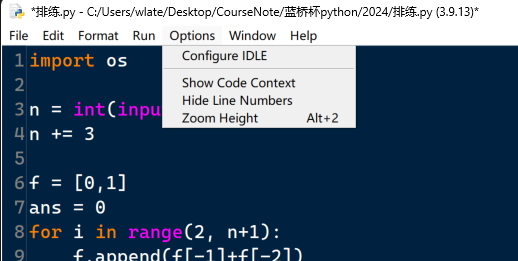
Options-Configure IDLE设置代码高亮。
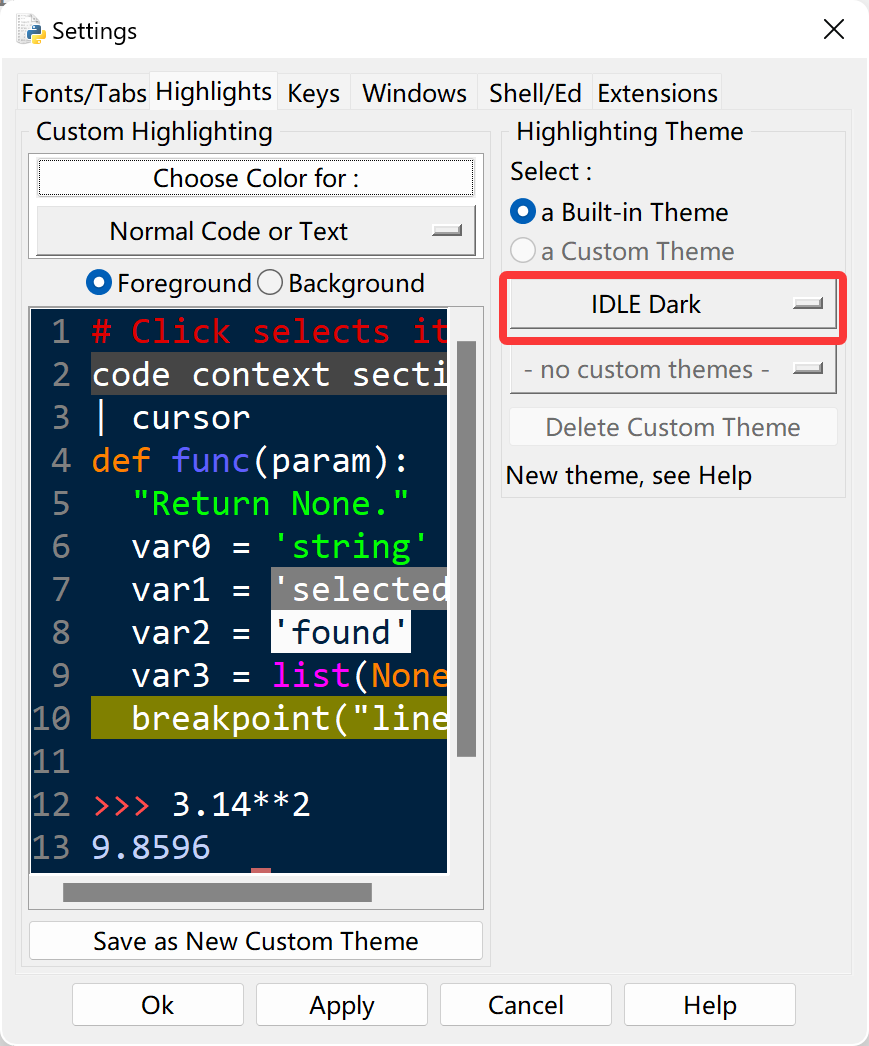
字体我设置的是Cascadia Mono,也可以用几乎每台电脑都有的Consolas。
主题在这里改成黑色,或者就白色的也行。
代码补全,有些低版本的IDLE没带,所以我平时准备蓝桥杯时也不开代码补全。就不记录了。推荐准备的时候用考场上一样的配置(也就是先不用vscode,尽可能多用IDLE)。
一. 调试工具
输入重定向
对应C++里的freopen。
sys.stdin = open("1.txt", "r")对拍
一个简单的对拍代码,调用暴力的std.py、测试的未必正确的正解test.py、数据生成器gen.py。
import subprocess as spimport sys
n = 100for i in range(n): print(f"test #{i} ", end="") sp.run(["python", "gen.py"], stdout=open("in.txt", "w")) sp.run(["python", "std.py"], stdin=open("in.txt","r"), stdout=open("out1.txt", "w")) sp.run(["python", "test.py"], stdin=open("in.txt","r"), stdout=open("out2.txt", "w")) with open("out1.txt", "r") as f1, open("out2.txt", "r") as f2: out1 = f1.read() out2 = f2.read() if out1 == out2: print("pass") else: print("failed") break二. 基础问题
排序
a = sorted(a, key = lambda x: x[1], reverse = True)日期与时间
直接看文档
import datetimehelp(datetime)在打印出来的
CLASSES builtins.object date datetime time timedelta tzinfo timezone可以看见继承关系。例如datetime继承自date。
以这题为例:https://www.lanqiao.cn/problems/16955/learning/
一些函数直接看help。
输出一个整数,表示在公元 年 月 日到 年 月 日期间,有多少个月的第一天是周日。
from datetime import date, timedelta
s = date(1901, 1, 1)t = date(2000, 12, 31)
dt = timedelta(days = 1)last = -1ans = 0while s != t: if last != s.month: if s.weekday() == 6: ans += 1 last = s.month s += dtprint(ans)还有这题:https://www.lanqiao.cn/problems/2271/learning/
import osfrom datetime import date, timedelta
now = date(2022, 1, 1)ans = 0
while now.year == 2022: now += timedelta(days=1) if now.weekday() == 5 or now.weekday() == 6 or now.day in [1, 11, 21, 31]: ans += 1
print(ans)以及这题https://www.lanqiao.cn/problems/1452/learning/
import os, time
t = int(input()) // 1000
print(time.strftime("%H:%M:%S", time.gmtime(t)))输出格式
类似c++。
# 百分比格式ratio = 0.75print(f"{ratio:.1%}") # 输出: 75.0%
# 科学计数法large_num = 1234567print(f"{large_num:.2e}") # 输出: 1.23e+06
# 二、八、十六进制number = 42print(f"{number:b}") # 输出: 101010 (二进制)print(f"{number:o}") # 输出: 52 (八进制)print(f"{number:x}") # 输出: 2a (十六进制小写)print(f"{number:X}") # 输出: 2A (十六进制大写)进制转换
实际上python的int函数是可以用base来指定转换基数的。
例题:https://www.lanqiao.cn/problems/19807/learning
import osimport sys
print(int("10", base=2))三. 注意事项
递归深度
python默认递归深度大概1000,容易爆栈。
查看递归深度
import sysprint(sys.getrecursionlimit())设置递归深度
import sysprint(sys.setrecursionlimit(3000))可以help(sys)来查看,感觉这个不好记住。
ASCII码转换
获取一个字符的ASCII码,可以用ord。
ch = 'a'print(ord(ch))如果要将一个数值,按照ASCII码,转换成字符,就要用到chr函数。
ch2 = chr(97)print(ch2)四. 数据结构
优先队列:heapq
python中用heapq库来实现优先队列功能。
例题:https://www.lanqiao.cn/problems/741/learning
import sys, os
# sys.stdin = open("1.txt", "r")
n = int(input())a = list(map(int, input().split()))ans = 0
import heapqque = []for x in a: heapq.heappush(que, x)while len(que) != 1: u = heapq.heappop(que) v = heapq.heappop(que) ans += u + v heapq.heappush(que, u + v)print(ans)双端队列:deque
用的是collections库的deque。
例题:https://www.lanqiao.cn/problems/511/learning
import sys, os
m, n = map(int, input().split())words = list(map(int, input().split()))
from collections import dequeque = deque()inque = set()ans = 0
for w in words: if w in inque: continue ans += 1 if len(que) >= m: old = que.popleft() inque.remove(old) que.append(w) inque.add(w)print(ans)五. 数学库
python数学库比C++感觉多了不少东西。
组合数函数
factorial(x) - 计算阶乘,直接返回x!
comb(n, k) - 计算组合数,即二项式系数
perm(n, k) - 计算排列数
数论函数
gcd(*integers) - 计算多个整数的最大公约数
lcm(*integers) - 计算多个整数的最小公倍数
isqrt(n) - 计算整数平方根(向下取整)
高精度
fsum(seq) - 高精度浮点数求和,避免累积误差
ceil(x)和floor(x) - 向上和向下取整
isclose(a, b, *, rel_tol=1e-09, abs_tol=0.0) - 判断两个浮点数是否近似相等(处理浮点误差)
除此之外,python内置了快速幂,pow(base, exp[, mod])
# 带模的快速幂(更高效)result = pow(2, 10, 1000000007) # 计算2^10 % 1000000007